
I was asked. “What’s your favourite tree?” It was an exercise to celebrate National Tree Week.
Wirral Street Tree 09452. a crab apple in Frankby Road, Meols.
This a tree to get you thinking:
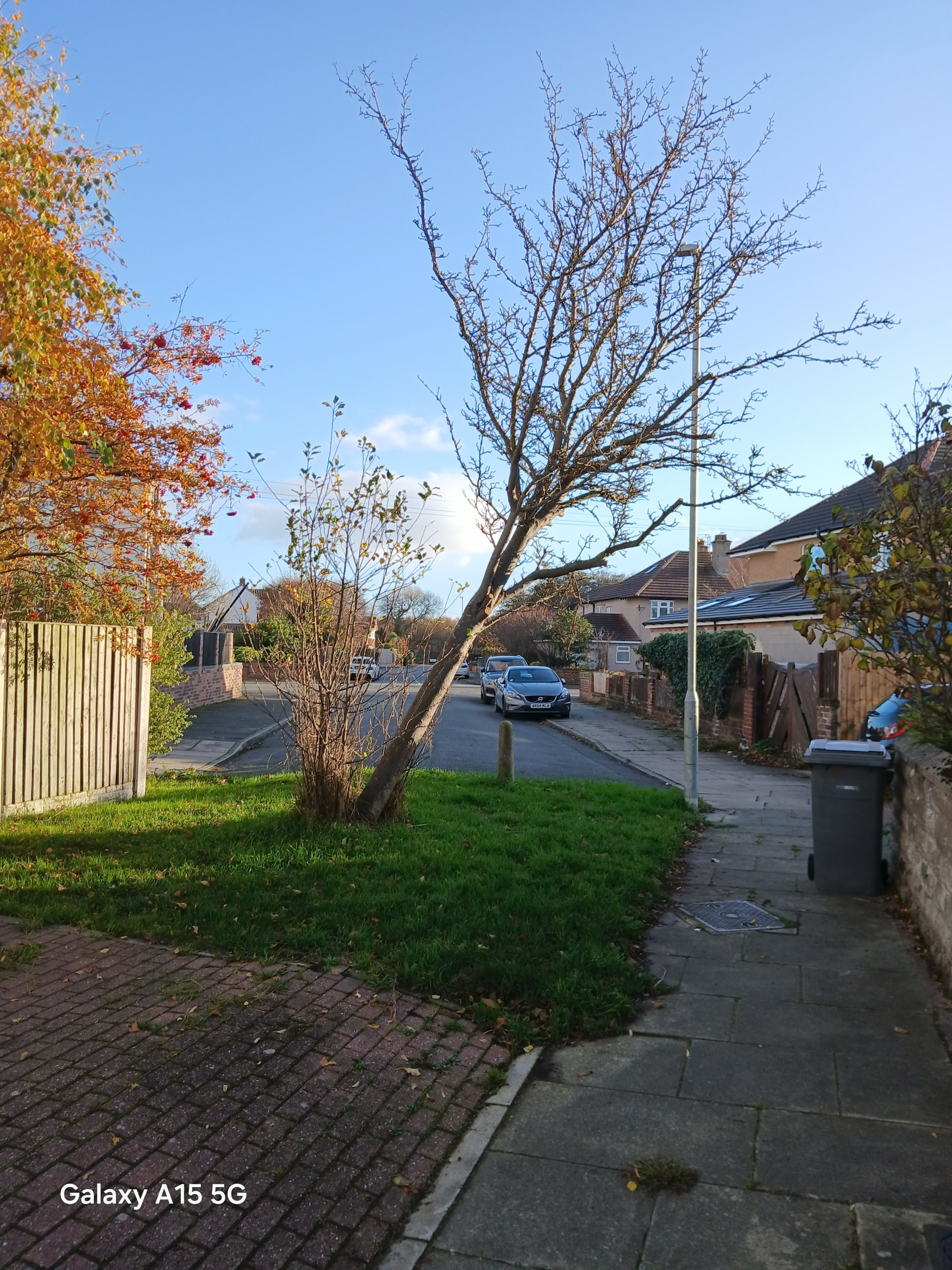
this is a crab-apple, growing on an apple rootstock, possibly a wilding rootstock. It was planted to stop people taking their vehicles from one cul-de-sac to another. It doesn’t look like a street tree is meant to – it’s not a well-behaved lollipop of a tree. The fruits are bright red crab apples, but the fruits on the suckers growing from the base of the trunk and the rootstock are smallish but tasty green apples. It’s normally the other way round – cultivated apples growing on a rootstock derived from crab-apples, and you rarely see the fruit growing from any rootstock. Some apple-trees grow “Burr Knots” or “Pitchers” – side shoots from the base of the trunk or from the roots. It’s still quite rare, and you could take the pitchers to grow as separate trees.
But even then, this tree is odd.
The tree has started to lean, even though the branches on one side seem to be growing taller and thicker to try to compensate, bringing more weight to that side in an effort to balance better. It’s so easy to talk in terms that the tree is like a person, thinking and planning what to do. But the tree is stressed – and that’s perhaps shown by the growth of side-shoots. It’s had a lot of fruit this year on both parts of the tree – often a sign that the tree is having a last go to pass on seeds when it’s under threat.
In France, Spain or Italy, it’s normal to prop up a leaning tree like this with a big forked branch, and perhaps each year nudge it a bit more until it’s better balanced and less likely to topple. In UK I’ve rarely seen props used – it seems more likely that the tree would be seen as being at risk of leaning too far and toppling in a wind, so it would be removed, especially if the roots creak when moved – perhaps a weakness that can contribute to its falling?
This tree is a challenge. Most of the trees in the neighbouring gardens have been cut back or have died. The road used to be full of birdsong as blackbirds, thrushes and Winter visitors used the bigger trees to perch and sing out their lust and their defence of the patch of territory that they claimed. The bluetits, goldfinches and other small birds still abound in this tree and in the recovering trees around them, but the bigger birds are slow to find new sounding posts in the street. So I really don’t want this tree to go and it’s a challenge to find a solution to prop it up, and to preserve the odd arrangement of a crabapple, apparently grafted on to the roots of a fruiting Orchard apple tree.
I also have a very personal reason for wanting to keep this tree. I was currently writing an article about old ways of propagating apple trees, including the use of epicormic shoot growth – pitchers or side shoots – to plant on as new trees.
I came out of my house and, for the first time, I had a proper look at this tree. It got me thinking.
Right under my nose – relevant to what I was attempting to write about, but taking me in a different direction.
It was a good reminder that many less spectacular trees have value and are a source of inspiration.
It was a reminder to look at all trees, appreciate them, even when they are not beautiful or even tidy.
It was a reminder of the wonder of how trees grow and adjust to their environment.
It was a reminder that there are other tasks for tree wardens and champions, besides planting new trees, perhaps propping up infirm things like this tree? and being old and infirm myself, I can identify with it and sympathise.
It has me asking ecologists and tree experts if I’d read the tree’s situation correctly and what were their conclusions?
So it’s worth preserving and, for all its challenges, it deserves consideration as a favourite tree.
I had a nagging thought that the tree had actually come to me for attention…
Afterword: On 25th August, 2026, I came home to discover that the crab-apple part of the tree was gone. I’d thought that the angle of inclination had increased, and sure enough, it had gone even worse since I last had looked. When I switched on my computer, there was a message from the Landscape Manager:
Hi Dave,
I hope you are well.
Unfortunately, I have some sad news. We have received a report that the tree’s root plate failed today. Please see the attached photo for reference.
As a result, we need to proceed with its removal. I wanted to let you know.
Many thanks
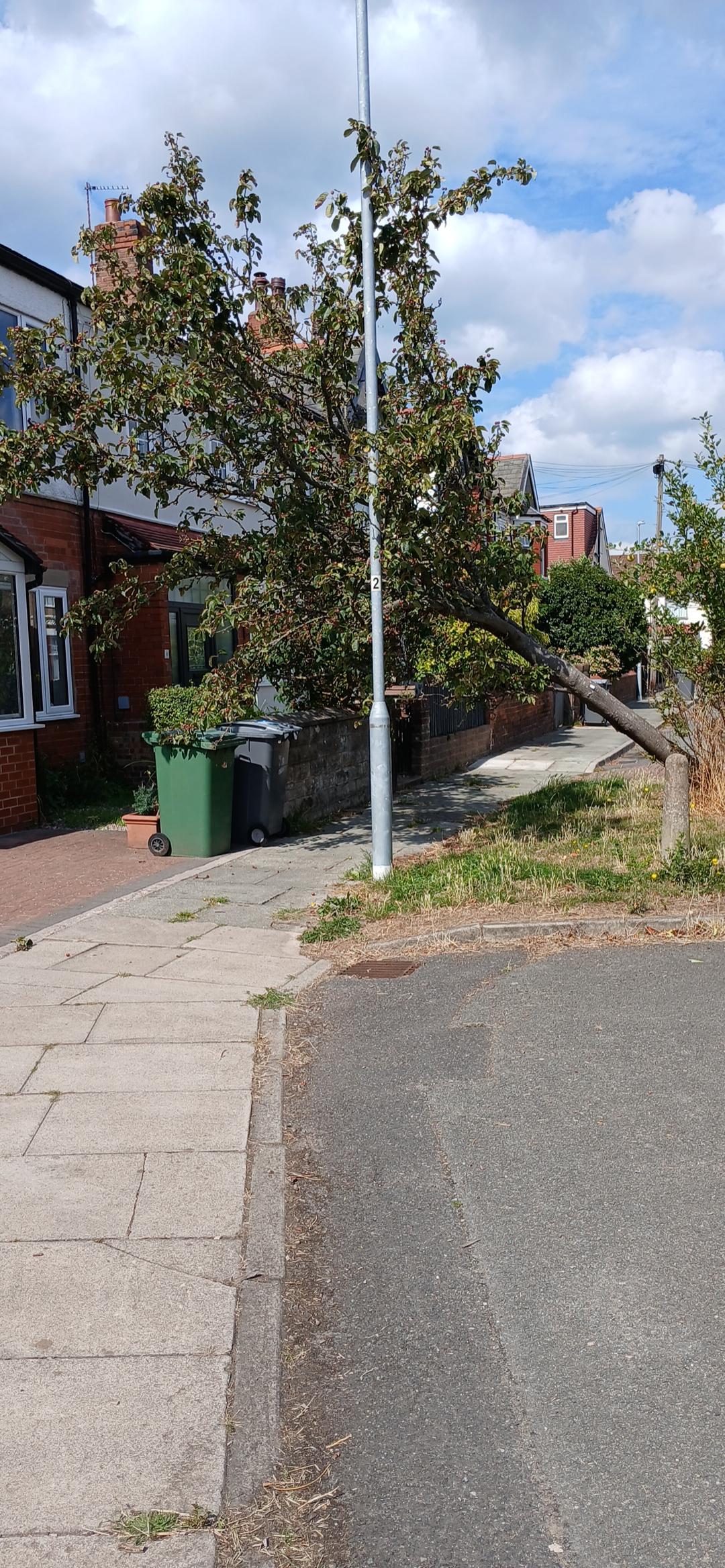
I was very grateful for the consideration shown in sending me a personal reply, and the picture makes perfect sense of the decision. I feel reassured, that although it was sad, that the Wirral Tree Strategy is managed by people who care for our trees.

 Ellwandery
Lovely text, Dave. You got me thinking about my grandfather Ralph, and I found this:
Click to access Hawley_Ralph.pdf
It’s long-ish; not appealing if your eyes are healing. Perhaps for another day.
Martha
http://www.avg.com/email-signature?utm_medium=email&utm_source=link&utm_campaign=sig-email&utm_content=webmail Virus-free.www.avg.com http://www.avg.com/email-signature?utm_medium=email&utm_source=link&utm_campaign=sig-email&utm_content=webmail <#DAB4FAD8-2DD7-40BB-A1B8-4E2AA1F9FDF2>