
 Click on this link to listen to an international version of a recent radio programme on BBC North Radio Merseyside’s “Folkscene.”
I talked to musicians and restauranteurs about the contradictions of Catalan food and music – some great styles that have quickly gone from almost unknown secrets of ages-old traditions, to cutting edge innovations and ground-breaking fusions. The revivals, rediscoveries and re-examinations of the solid traditions uncover real beauty and value in the process.
Many years ago I had comments and complaints about my obsession with the minutiae of food, cookery, traditional music and recipes. I asked my friends what they thought.
“No it’s not a mental abnormality,” said Simone, a fidulaire and music therapist, then based in Barcelona, “You just suffer from Geography – you’re really a Catalan, just born in the wrong place.” I’d already formed a fondness for Catalunya, and shared the local passion. So this was both reassuring and provided every justification for keeping up my interest and enjoyment and developing a greater involvement.
Catalan food was described in 1988 by writer Colman Andrews in his celebrated book, “Catalan Cuisine” as “Europe’s Last Great Culinary Secret.” It had a capacity to delight because of the richness and quality of local ingredients, the sunshine, the Mediterranian, the climates and microclimates, the legacy of overlapping and mingling diverse cultures from the Carthaginians to the Columbians, and above all, an expectation and confidence of the Catalans that their food is excellent. The cuisine mostly lives up to that, but over the last century or so the food has changed.
The good peasant cookery grew into an elegance, replacing the classic French cuisine in the more fashionable restaurants. The more recent styles and fashions of fusion, chemical and physical wizardry, showmanship and drama in presentation and preparation have excelled in Catalunya like nowhere else. There is much in the newest cuisines that revolves around the experimental, the theatre and enchanting pyrotechnics. We note also a growing awareness, that for most people who simply enjoy good food as food, not as spectacle, it’s time to move back to the deep Catalan roots.
The years of repression and famines during the civil war and dictatorship gave extra poignancy to the nostalgia and sense of national and family identity that weaves through the sense of taste. “Many of the old varieties of crops have a special taste, and although they are not commercially viable, the farmers retained these for family use. We collect and cultivate these and make them available to recover some special flavours and textures that would otherwise die out ” explained the head of the department of food heritage at the La Fundació Alícia . He also explained that not everything in that heritage is wonderful or viable nowadays: some of the food remembered by older generations with nostalgia is tough or less flavoursome or less healthy than newer varieties. The teaching and conservation work develops a critical awareness over the twin concerns of food and health. A devotion to science and research is in the very practical context of how it can make an impact on the cuisine and eating habits of a nation. Alícia is a focal point in the development of the “mediterranian diet” but as importantly has sessions for visiting school children and international student-chefs to learn about “Granny’s lettuce varieties” and techniques of flavour capture and enhancement. Its ultra-modern complex of food laboratories and demonstration kitchens has gardens that were once part of the adjacent medieval monastery, Mon S. Benet. As the programme says, Catalunya’s contradictions include a very local identity which has always embedded cultural mixings, a unique combination of a continuing, living mediaevalism, a heritage of modernism and a history of innovation. These contradictions run through their cuisine and their music.
It’s the passion running through the music and food of Catalunya which lifts them into something special and gives the vitality, integrity and strength of identity which I admire so much, as a role model for other nations to invest in their own music-making and cooking.
“Folkscene” is the longest running music programme anywhere on the dial, and thanks to the generosity of Stan Ambrose and Geoff Speed, who have run this programme for BBC Radio Merseyside for over 45 years, I could share this personal passion with the programme’s lovely audience. The programme is made possible originally by Folkscene’s dedication to passing on musical traditions. Geoff Speed had kindly asked me to present the programme while he is in hospital, recovering well from a serious operation. He shares an enjoyment of Catalunya and the Fira Mediterrania in Manresa, as well as of the food of the region. I’m grateful also to Pep Sala, the musician, for his comments in the programme and sharing of his love of Catalan food. I can commend strongly his website at Artencuina.
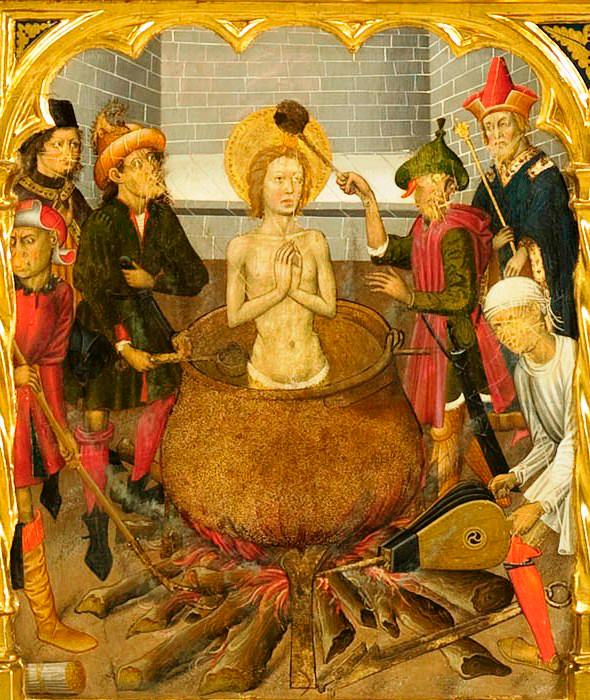
The illustration above, courtesy of National Museum of Art of Catalunya, is of the martyrdom of St John the Evangelist, being boiled in oil, with an early illustration of cooking utensils: not a recipe to try at home…..
and another feature about music from this enchanting area is about Silvia Perez Cruz and Raul Fernandez Miro

 Ellwandery