
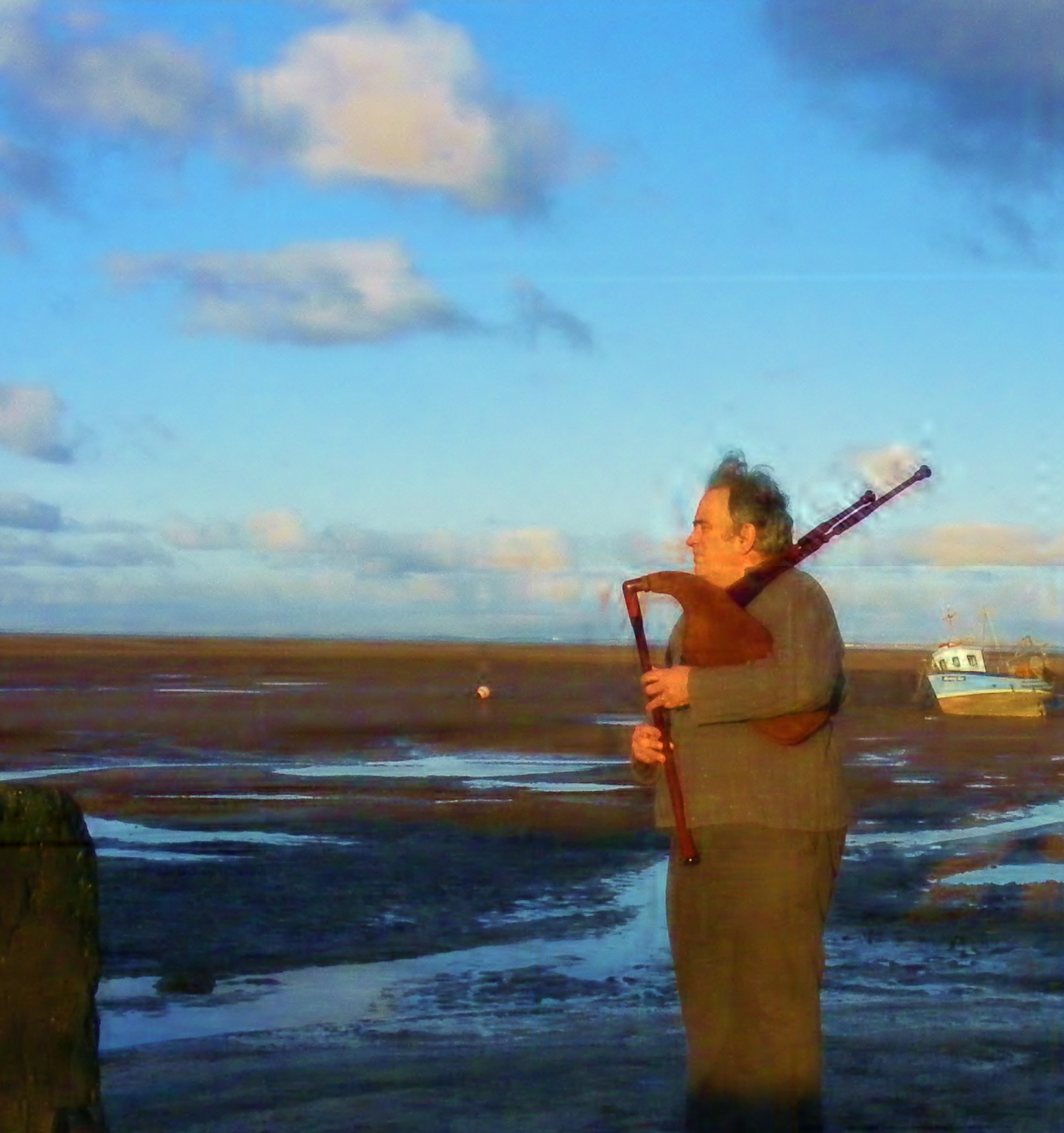
playing the bagpipe by the shore at Meols
I’m having a fragrant start to the week: I’m outside in my garden sawing and splitting wild cherry logs for the woodstove. They smell good like cherry toffee and through the open window to my kitchen I can pick up the smells of the week’s coffee roasting and the fresh oatmeal and wheaten loaves baking for breakfast. Before I take a walk to the sea with the dogs, I’ve got something to write, so perhaps I’ll pull some of the morning’s fragrance into it also.
My friend Martha has a niece, Emmary, in Kansas, who asked her aunt to speak to all her friends and beg them to send the story of the place where they each live. Emmary is collecting the stories for her class at school. I have lots of nieces and nephews, so I know how important it is to do as they ask.
I live in Meols, Wirral, England, United Kingdom of Great Britain and Northern Ireland
That’s a very big name for the very little place where I live.
U.K. (or United Kingdom) is one big island and a bit of another big island, called Ireland, and lots of little ones. I’m right in the middle of them all and very near the sea. In the morning when I go out of my house, if the wind blows from the North or West, I can smell the sea. It might not be a nice smell: salty dead fish, old seaweed and the smells the whales make when they’ve eaten too many beans – but it’s a fine smell and whenever I smell the sea, anywhere in the world, it reminds me of home. The other things I can smell on some days are the chocolate and baking smells from the Cadbury’s Biscuit Factory about a mile away. The factory makes all sorts of what you’d probably call cookies and brownies, but I can only smell it when the wind blows from the East. When the wind blows from the South, I can smell the farms, the cows and the grass and trees from the countryside.
Meols is a funny name for a place. Most people don’t know how to say it properly, and call it “meals” or “Meee- oles” If you live here, you call it “Mells” to sound like “smells.” I nearly said to sound like “bells,” but that might be a bit confusing if you try and make the noise of a bell and, anyway, there are lots of smells, as I just told you.
Meols is a very old name, and it comes from what the Vikings called the place, because it was their name for the sand-dunes, or big hills of sand which the splashy sea puts on the shore.
Now, I suppose I’d better tell you about the Vikings. 1,100 years ago, (in 902 A.D.) they came to Meols to live. They came in their big boats from Norway, at the top of the map, and went first to live in Ireland. The people in Ireland got annoyed with them and told them to move on, because they were a noisy bunch with too many loud parties and I think they stank a bit, because they ate lots of onions and wild garlic. So they came to settle in other parts of England and they liked Meols. Recently some scientists found a big Viking boat which had been buried underground for 1,099 years just by my house and soon the scientists will dig it up and put it in a museum. They found it by using a special machine which can find little bits of old things underground. It might well be that it could still smell 1,100 year old onion pies or whatever the Vikings ate.
The shore and the bottom of the sea here is very sandy. You might remember that I told you that the sea is very splashy and the big waves sometimes move the sand round. Every day there are high tides, and low tides. This means that sometimes the sea at high tide comes closer to houses, and you can’t see the sand. Sometimes it’s low, so there’s lots of sand to walk on. Sometimes things that have been buried under the sand for ages get washed up on the shore, especially when there’s been windy weather and especially splashy sea. For many years people have found treasures that come from the time when the Vikings lived here, and some even older treasures from the days of the Romans, 2000 years ago. So I’m just going now, down to the shore with my big dog to see if I can find anything. She sniffs as she walks along. I don’t know what she can smell and we’ve never found anything ourselves, except the stumps of old trees, because there used to be dry land and a big forest in a bit of the shore which the sea washed away. This is what people here call the “drowned forest” and it’s a bit spooky when the trees stick up through the sand, and you walk through a forest that’s only as high as your knees. Many of the museums in England have loads of old coins and bits of metal that came from here. The museum staff ask us to tell them if anyone finds anything old, in case it can tell them more about people used to live, long, long ago.
Perhaps today we’ll find out if there are any old Viking garlic brownies.

 Ellwandery
I’m grateful that the request to write for an unknown younger reader made me think about how to explain in very simple terms my everyday world and the heritage I take so much for granted.
The serious bits about the early history of Meols can be seen through the website and links at http://www.liverpoolmuseums.org.uk/mol/archaeology/field/projects/meols/index.aspx
Another spin off is a sound piece about Oxton, an urban village in my area: http://www.prx.org/pieces/78319-tales-from-the-secret-gardens-of-oxton
I start just thinking I’ll read a bit and end up having read the whole thing. You can write my cousin.
thanks for the comment! I’m finding your work very inspiring, too. It’s a strange co-incidence of family fascinations with bread: http://gregsbread.com/